


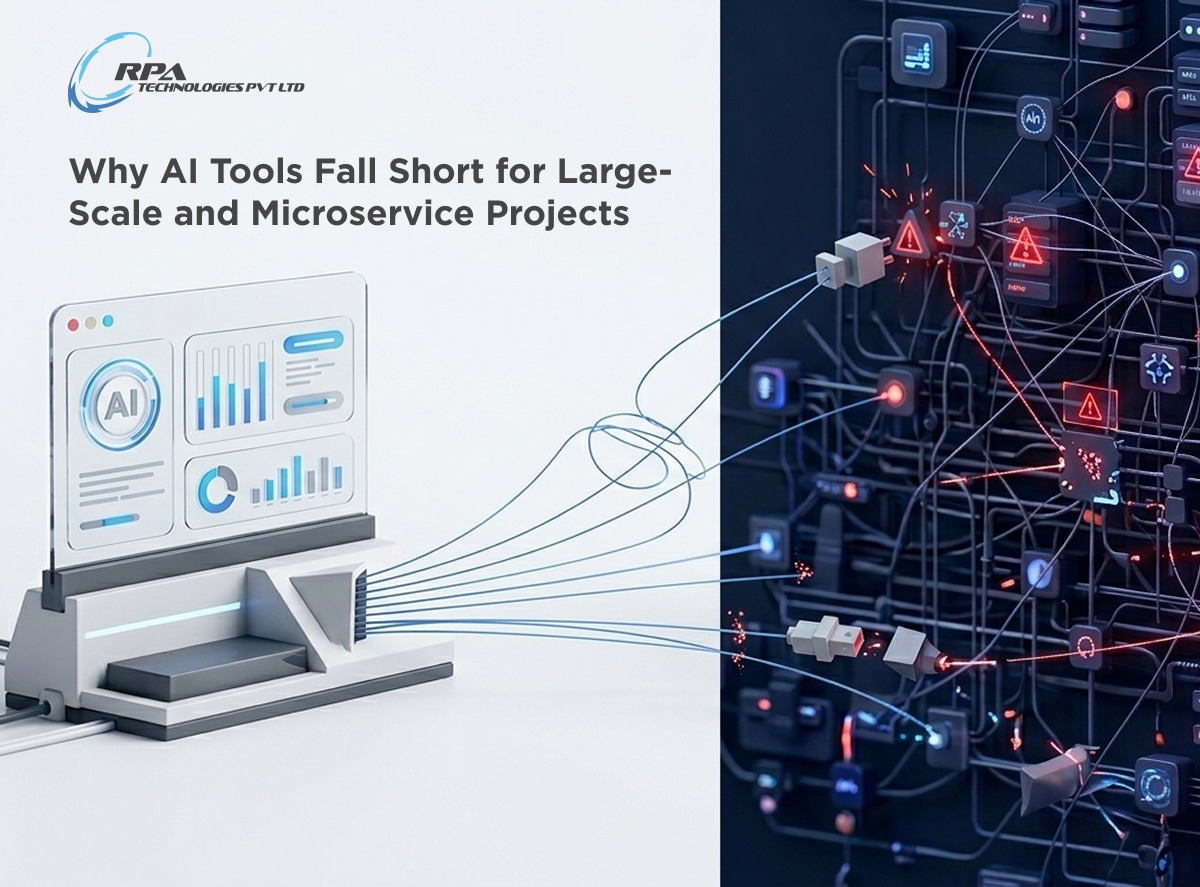
Why AI Coding Tools Struggle With Large-Scale and Microservice Software Systems
Artificial intelligence is rapidly transforming how modern software is built. AI coding assistants such as GitHub, Copilot, ChatGPT, and other automated development tools have significantly improved developer productivity. These tools can generate code snippets, automate repetitive tasks, suggest documentation, and even help developers troubleshoot errors.
For small projects, prototypes, or simple applications, AI tools can dramatically accelerate development. Developers can quickly generate boilerplate code, experiment with different solutions, and reduce time spent on routine programming tasks.
However, when it comes to building large-scale enterprise software systems, particularly those based on microservice architectures, AI coding tools still face significant limitations.
Enterprise software development requires far more than writing functional code. It involves careful system architecture, scalability planning, strong security practices, and long-term maintainability. While AI can assist with parts of the development process, relying on automated tools alone to design complex systems can introduce serious risks.
This article explores why AI coding tools struggle with enterprise-scale software systems and why experienced engineers remain essential for building reliable and scalable applications.
The Rise of AI in Software Development
Over the past few years, AI-driven development tools have gained widespread adoption among developers and organizations. These tools can assist in multiple stages of the development lifecycle and help teams move faster.
Modern AI coding tools are capable of:
- Generating code from natural language prompts
- Suggesting improvements to existing code
- Helping debug errors and propose possible fixes
- Automating technical documentation
- Speeding up boilerplate creation for frameworks and APIs
For individual developers or small teams building early-stage applications, this level of automation can be extremely valuable. AI tools reduce friction during development and help engineers focus on solving higher-level problems.
However, building production-grade enterprise systems requires much more than generating working code. It demands deep architectural planning, thoughtful system design, and coordination between multiple services, teams, and infrastructure layers.
This is where the limitations of AI-generated code become more visible.
Why AI Coding Tools Struggle With Enterprise-Scale Systems
While AI tools can generate functional code quickly, they often lack the broader context required to design reliable and scalable systems. Enterprise software operates in complex environments that involve distributed systems, integrations, security requirements, and long-term maintenance considerations.
Below are several reasons why AI coding tools face challenges when applied to large-scale software development.
Code Quality and Maintainability Challenges
AI-generated code can often solve a specific prompt or problem efficiently. However, enterprise systems require code that remains maintainable and understandable over long periods of time.
Large applications are typically maintained by multiple teams and evolve continuously as new features and improvements are added. To support this process, code must be:
- Well structured
- Modular and reusable
- Consistently documented
- Easy for other developers to understand and extend
AI-generated code sometimes prioritizes immediate functionality over long-term maintainability. While the output may work correctly, it may not follow the architectural patterns or coding standards used within the project.
For example, an AI tool might generate a solution that solves a particular problem quickly but does not align with the application's design architecture. Over time, this can lead to technical debt, where systems become harder to maintain and update.
In enterprise environments, maintainability is just as critical as functionality. Poorly structured code can slow down development teams and increase operational risks.
Scalability Issues in Microservice Architectures
Modern enterprise applications often rely on microservice architectures. This approach breaks complex applications into smaller, independent services that communicate with each other through APIs.
Microservices offer several advantages, including flexibility, scalability, and easier deployment. However, they also introduce additional complexity.
Designing scalable microservices requires careful planning around several factors, including:
- Service orchestration
- Load balancing
- Distributed communication
- Fault tolerance
- Container orchestration
- Infrastructure scaling
AI tools typically generate code for individual components rather than designing complete system architectures. While they can produce service endpoints or API handlers, they may not account for how these services interact under heavy traffic or failure conditions.
For example, an AI-generated service might function correctly in isolation but fail to handle situations such as service downtime, network latency, or unexpected traffic spikes.
Without thoughtful architectural design, microservice-based systems may struggle to scale effectively as user demand grows.
Security Risks of AI-Generated Code
Security is one of the most critical aspects of enterprise software development. Applications often handle sensitive information such as customer data, financial records, and internal business operations.
AI-generated code can sometimes introduce vulnerabilities if it is not carefully reviewed by experienced engineers.
Common security issues that may appear in automated code include:
- Weak authentication mechanisms
- Insufficient input validation
- Insecure API endpoints
- Exposure of sensitive data
- Improper encryption practices
AI models generate code based on patterns learned from large datasets. However, not all examples within these datasets represent secure development practices. As a result, the generated code may replicate outdated or insecure approaches.
Without proper security reviews, organizations risk deploying systems that expose vulnerabilities to attackers.
Experienced engineers typically design systems with security as a core principle, implementing strong authentication, authorization, and encryption practices throughout the architecture.
Integration Complexity in Modern Software Systems
Enterprise applications rarely operate in isolation. Instead, they rely on multiple internal and external systems working together to support business operations.
Common integrations in modern software systems include:
- Payment gateways
- Customer relationship management (CRM) platforms
- Analytics tools
- Third-party APIs
- Cloud infrastructure services
- Messaging queues
- Data processing pipelines
Each integration introduces unique challenges and potential edge cases. AI tools can generate code that connects to external services, but they often fail to account for the wide range of issues that occur in distributed environments.
For example, integration challenges may include:
- API rate limits
- Network failures
- Inconsistent data formats
- Partial service outages
- Timeout handling
Experienced engineers anticipate these scenarios and design systems that can recover gracefully from failures.
AI-generated solutions may perform well under ideal conditions but struggle when real-world complications arise.
Debugging and Maintenance Challenges
Debugging is one of the most complex aspects of software development. When developers write code themselves, they understand the reasoning behind each design decision.
This context helps them quickly identify issues when problems occur.
AI-generated code, however, can often feel like a black box for development teams. The logic may function correctly, but the reasoning behind certain implementations may not be immediately clear.
When issues arise, teams may need to spend significant time:
- Understanding how the generated code works
- Identifying hidden dependencies
- Refactoring poorly structured logic
Over time, this can increase maintenance costs and slow down development workflows.
For large systems where uptime and reliability are critical, unclear code structures can become a serious operational risk.
Challenges for Non-Technical Teams Using AI
AI coding tools have also created the impression that non-technical individuals can build full software systems without deep programming knowledge.
While AI tools do lower the barrier to entry, building real-world applications still requires technical expertise.
Non-technical teams may encounter several challenges when relying heavily on AI-generated code.
Difficulty Understanding the Code
Programming involves complex concepts such as data structures, logic flows, frameworks, and system architecture.
Even when AI generates functional code, non-technical users may struggle to understand:
- What the code is doing
- Why it works the way it does
- How different components interact
Without this understanding, maintaining and improving the system becomes extremely difficult.
Debugging Can Become Overwhelming
Debugging software can be challenging even for experienced engineers.
When errors occur, developers must analyze logs, trace code execution paths, and identify root causes.
For non-technical users, this process can quickly become overwhelming. Error messages may appear confusing, and AI-generated suggestions may not always resolve the underlying issue.
This can lead to frustration, project delays, and increased reliance on external developers.
Communication Gaps Between Teams
Software development projects require collaboration between multiple stakeholders, including developers, product managers, designers, and business leaders.
When non-technical stakeholders rely heavily on AI-generated solutions without understanding the technology behind them, communication gaps can emerge.
These gaps may include:
- Misunderstanding technical limitations
- Underestimating development timelines
- Difficulty explaining issues to engineering teams
Such misalignment can slow down projects and create unrealistic expectations.
The Learning Curve Still Exists
AI tools can generate code quickly, but they cannot replace foundational programming knowledge.
Understanding concepts such as:
- Software architecture
- System design
- Data flow
- Testing strategies
- Deployment pipelines
remains essential for managing production systems.
Without this knowledge, teams may struggle to scale or adapt the applications they build.
How AI Should Be Used in Software Development?
Despite these limitations, AI tools remain incredibly valuable when used correctly. Instead of replacing developers, AI works best as a productivity enhancer that supports engineers throughout the development process.
Some of the most effective uses of AI in software development include:
- Generating boilerplate code
- Writing documentation
- Suggesting test cases
- Assisting with code refactoring
- Exploring alternative technical approaches
When combined with experienced engineers, AI tools can significantly accelerate development while maintaining high standards of quality and security.
Why Experienced Engineers Still Matter
Enterprise software development requires expertise that extends far beyond writing code.
Experienced engineers bring critical skills such as:
- System architecture design
- Performance optimization
- Security planning
- Infrastructure management
- Reliability engineering
- Long-term maintainability planning
These decisions often involve complex trade-offs based on real-world constraints and business requirements.
AI tools currently lack the contextual understanding needed to fully evaluate these factors. Human engineers remain essential for guiding technical decisions and ensuring that systems remain scalable and reliable over time.
Best Practices for Organizations Using AI Tools
Organizations that want to benefit from AI-assisted development should focus on combining automation with human expertise.
Several best practices can help teams use AI tools effectively.
Use AI as a support tool rather than a replacement for engineers.
AI should assist developers with repetitive tasks while architectural decisions remain under human oversight.
Encourage responsible use of AI tools.
Developers should review and validate AI-generated code before integrating it into production systems.
Invest in strong documentation.
Clear documentation helps teams understand system behavior and reduces reliance on individual developers.
Provide training for teams.
Ensuring that both technical and non-technical teams understand the capabilities and limitations of AI tools improves collaboration.
Promote open communication between stakeholders.
Strong communication helps align business goals with technical realities and reduces misunderstandings during development.
Conclusion: AI as an Assistant, Not a Replacement
AI coding tools represent a major advancement in software development productivity. They help developers move faster, reduce repetitive tasks, and explore potential solutions more efficiently.
However, building enterprise-grade software systems requires much more than automated code generation.
Microservice architectures, security considerations, system integrations, and long-term maintainability all demand careful planning and deep technical expertise.
AI tools are powerful assistants, but they are not replacements for experienced engineers.
Organizations that combine the speed of AI with the expertise of skilled developers will be best positioned to build secure, scalable, and reliable software systems in the future.


Comments