


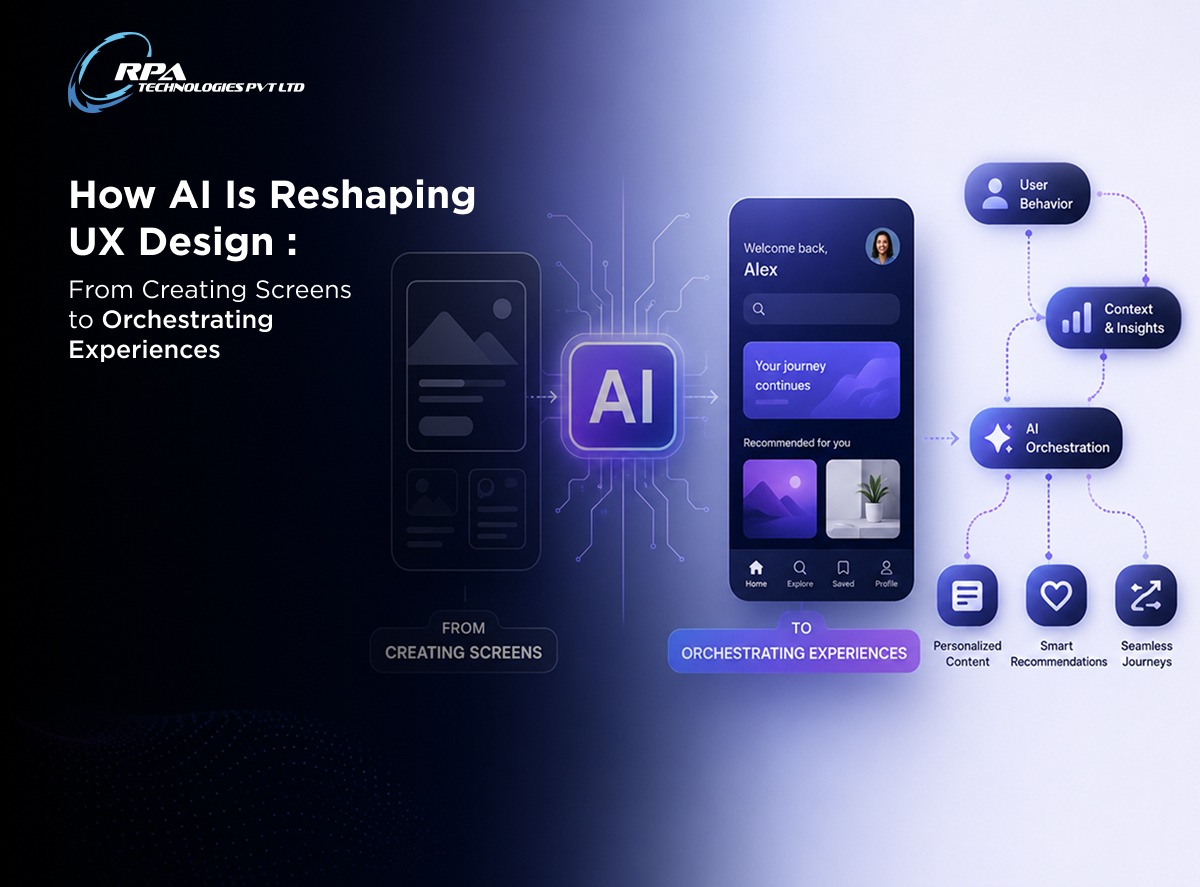
How AI Is Reshaping UX Design: From Creating Screens to Orchestrating Experiences
Artificial Intelligence is changing almost every digital profession, and UX design is no exception. Over the last few years, AI-powered tools have evolved from simple assistants into capable design partners that can generate layouts, write content, analyze research, and even produce working code.
As a result, many designers are asking the same question: Is AI replacing UX designers?
The short answer is no.
What AI is actually doing is transforming how UX professionals work. Tasks that once required days or weeks can now be completed in hours. The focus is shifting away from manual production and toward strategic thinking, decision-making, and problem-solving.
Rather than eliminating designers, AI is redefining their role. The future belongs to professionals who understand how to combine human insight with AI-powered efficiency.
The Traditional UX Design Process
Before understanding AI's impact, it helps to look at how UX design has traditionally worked. A typical UX project often involves:
- User research and interviews
- Competitor analysis
- Persona creation
- Journey mapping
- Wireframing
- UI design
- Prototyping
- Usability testing
- Design handoff to developers
Each phase requires significant time and effort. Research alone can take weeks. Creating multiple design concepts and iterations often adds more time to the project timeline.
While this process produces valuable outcomes, it can also slow down product development, especially when teams need to test ideas quickly. This is where AI is making a measurable difference.
AI Is Compressing Design Timelines
One of the biggest advantages of AI in UX design is speed. Tasks that once demanded hours of manual work can now be automated or significantly accelerated.
Instead of spending days creating initial layouts, designers can generate multiple interface concepts within minutes. Research insights that previously required extensive manual review can be synthesized almost instantly.
The result is a faster design cycle that allows teams to experiment, validate, and iterate more frequently.
However, speed alone is not the ultimate benefit. The real value lies in giving designers more time to focus on strategic decisions that influence user outcomes and business goals.
Rapid Prototyping Is Becoming the New Standard
Modern AI-powered design platforms are dramatically reducing the time required to move from an idea to a prototype.
Tools such as Lovable, Bolt, and Figma AI can generate user interfaces based on prompts, sketches, requirements, or product descriptions. Within minutes, designers can review multiple design directions instead of building everything from scratch.
This shift changes the role of the designer. Previously, much of the effort was spent creating screens. Today, designers are increasingly responsible for evaluating generated options, refining interactions, and ensuring alignment with user needs.
Rapid prototyping also enables better collaboration. Product managers, stakeholders, and developers can see concepts earlier, provide feedback sooner, and make decisions faster. This reduces costly revisions later in the project lifecycle.
Research Analysis Is Faster Than Ever
User research remains one of the most important parts of UX design. The challenge has always been volume.
Design teams often collect large amounts of data through interviews, surveys, support tickets, usability tests, and customer feedback channels. Reviewing and organizing this information can be extremely time-consuming.
AI tools are helping solve this problem. Platforms like Dovetail can analyze transcripts, identify recurring themes, cluster pain points, and surface key insights in seconds.
Instead of spending hours categorizing notes, researchers can focus on understanding what the findings mean and how they should influence product decisions. This allows teams to spend less time processing information and more time acting on it.
Automated Asset Creation Improves Productivity
Another area experiencing significant transformation is content and asset generation. AI can now assist with:
- Microcopy creation
- Error messages
- Button labels
- Product descriptions
- Localization
- Visual assets
- Icon generation
- Color palette recommendations
These capabilities remove many repetitive tasks from a designer's workflow. For example, instead of manually creating localized versions of interface content for multiple markets, AI can generate translations and variations almost instantly.
Similarly, visual asset generation helps teams quickly create supporting graphics during early design stages.
This doesn't mean designers stop making creative decisions. It means they can spend more time refining experiences rather than producing every individual asset manually.
The Shift From Creator to Curator
Perhaps the most important change is the evolution of the designer's role itself. Historically, designers were primarily responsible for creating interfaces.
With AI generating layouts, copy, and even code, the designer's role is increasingly becoming that of a curator and strategist.
Rather than asking:
"How do I design this screen?"
Designers are asking:
"Which solution best supports user goals and business objectives?"
This distinction is critical.
AI can generate dozens of options, but it cannot determine which option is most appropriate for a specific audience, product strategy, or brand vision.
Human judgment remains essential.
The ability to evaluate alternatives, identify trade-offs, and make informed decisions is becoming one of the most valuable skills in UX design.
Hyper-Personalization Is Changing User Experiences
AI is also influencing the experiences users interact with every day. Traditional interfaces are largely static. Every user sees the same layout, navigation structure, and content presentation. AI introduces the possibility of dynamic experiences.
Interfaces can adapt based on:
- User behavior
- Previous interactions
- Preferences
- Location
- Goals
- Context
Instead of presenting a single experience to everyone, products can tailor interactions to individual users.
For example, an e-commerce platform may reorganize categories based on browsing habits. A productivity application may prioritize features based on usage patterns.
This level of personalization can improve engagement and efficiency. However, it also introduces new design challenges around transparency, consistency, and user trust.
Designers must ensure that adaptive experiences remain understandable and predictable rather than confusing or intrusive.
The Gap Between Design and Development Is Shrinking
Another major shift is occurring at the intersection of design and engineering. AI-powered tools such as V0 and Claude Code can transform interface concepts into working frontend code with remarkable speed.
Traditionally, designers created mockups, developers interpreted those designs, and then built the final product. This handoff process often introduced delays and inconsistencies.
Today, AI is helping bridge that gap. Designers can generate functional prototypes that closely resemble production-ready applications. Developers can iterate faster because much of the initial implementation work is already completed.
As a result, the boundaries between design and development are becoming less rigid. Future UX professionals may need a stronger understanding of product systems, frontend logic, and implementation constraints than ever before.
Why Human Empathy Still Matters
Despite its capabilities, AI has significant limitations. The most important limitation is empathy. AI learns from historical data and patterns. It does not experience emotions, observe human behavior in real-world environments, or understand cultural nuances as people do.
Great UX design often comes from understanding things users cannot easily express. A frustrated customer may struggle to explain why a workflow feels difficult. An experienced researcher can observe behaviors, ask follow-up questions, and uncover deeper motivations.
These insights frequently drive the most impactful design decisions. No matter how advanced AI becomes, genuine human understanding remains central to creating meaningful experiences.
The Risk of Homogenized Design
Another concern is the growing similarity among AI-generated interfaces. Most AI systems learn from large collections of existing products and design patterns. As a result, generated outputs often reflect established conventions and widely adopted best practices.
While this can improve usability, it can also reduce originality. When every company relies on similar recommendations, products risk becoming visually and functionally indistinguishable.
Strong brands require unique identities. Designers play a crucial role in ensuring that products maintain distinct personalities, visual languages, and emotional connections with users. Creativity remains a competitive advantage that cannot be fully automated.
Ethical Responsibility Is More Important Than Ever
As AI becomes embedded in digital products, ethical design considerations become increasingly important. AI-driven experiences can unintentionally create problems such as:
- Algorithmic bias
- Privacy concerns
- Manipulative design patterns
- Lack of transparency
- Unequal user experiences
For example, recommendation systems may reinforce existing biases if not carefully monitored. Personalized experiences may collect more user data than necessary.
These challenges require human oversight. Designers must evaluate not only whether a solution works, but also whether it is fair, responsible, and aligned with user interests. Ethical judgment cannot be outsourced to algorithms. It remains a human responsibility.
How UX Designers Can Stay Competitive
The designers who thrive in the AI era are not those who resist change. They are the ones who learn to work effectively alongside AI. Several strategies can help professionals remain competitive:
Learn Prompting Skills
Knowing how to communicate effectively with AI tools is becoming a valuable skill. Better prompts often produce better outputs, faster iterations, and more useful design concepts.
Focus on Strategic Thinking
As execution becomes increasingly automated, strategic decision-making becomes more valuable.
Understanding business goals, user needs, market dynamics, and product strategy will differentiate top designers.
Strengthen Research Capabilities
Research, observation, and synthesis remain difficult to automate fully. Designers who can uncover meaningful insights will continue to play a critical role.
Build Cross-Functional Knowledge
Understanding development, analytics, product management, and AI systems can improve collaboration and increase career opportunities.
Develop Ethical Awareness
Organizations need professionals who can identify risks, evaluate consequences, and ensure responsible AI implementation. Ethical design expertise is likely to become even more important in the coming years.
The Future of UX Design
AI is not ending UX design. It is accelerating its evolution.
The profession is moving away from repetitive production work and toward higher-value activities such as strategy, research, decision-making, and ethical leadership.
Designers will spend less time creating individual screens and more time shaping systems, guiding product direction, and ensuring technology serves real human needs.
The most successful UX professionals will be those who embrace AI as a powerful tool rather than viewing it as a competitor.
Technology can generate layouts, summarize research, and write code. But understanding people, defining meaningful experiences, and making thoughtful decisions remain uniquely human strengths.
As AI continues to advance, the future of UX design will not belong to machines alone. It will belong to designers who know how to combine human judgment with artificial intelligence to create products that are both efficient and genuinely useful.


Comments